


Page 42 - CJOctober2026
P. 42
e
                                                                              Rehearsal Break
                                                                              R
                                                                                      arsal Br
                                                                                ehe
                                                                                                     ak
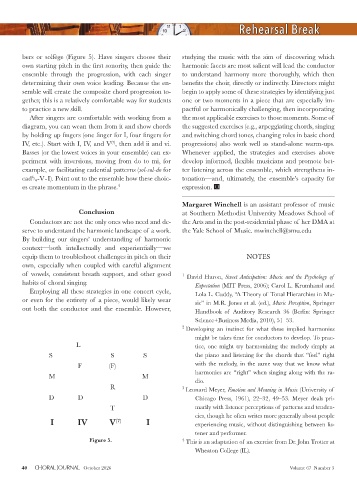
        bers or solfège  (Figure  5). Have  singers choose their   studying the music with the aim of discovering which
        own starting pitch in the first sonority, then guide the   harmonic facets are most salient will lead the conductor
        ensemble through the progression,  with each  singer   to  understand  harmony more  thoroughly,  which then
        determining their own voice leading. Because the en-  benefits the choir, directly or indirectly. Directors might
        semble will create the composite chord progression to-  begin to apply some of these strategies by identifying just
        gether, this is a relatively comfortable way for students   one or two moments in a piece that are especially im-
        to practice a new skill.                            pactful or harmonically challenging, then incorporating
           After singers are comfortable with working from a   the most applicable exercises to those moments. Some of
        diagram, you can wean them from it and show chords   the suggested exercises (e.g., arpeggiating chords, singing
        by holding up fingers (one finger for I, four fingers for   and switching chord tones, changing roles in basic chord
                                     (7)
        IV, etc.). Start with I, IV, and V , then add ii and vi.   progressions) also work well as stand-alone warm-ups.
        Basses (or the lowest voices in your ensemble) can ex-  Whenever  applied,  the  strategies  and  exercises  above
        periment with inversions, moving from do to mi, for   develop informed, flexible musicians and promote bet-
        example, or facilitating cadential patterns (sol-sol-do for   ter listening across the ensemble, which strengthens in-
           6
        cad / -V-I). Point out to the ensemble how these choic-  tonation—and, ultimately, the ensemble’s  capacity for
            4
        es create momentum in the phrase. 4                 expression.
                                                            Margaret Winchell is an assistant professor of music
                          Conclusion                        at Southern Methodist University Meadows School of
           Conductors are not the only ones who need and de-  the Arts and in the post-residential phase of her DMA at
        serve to understand the harmonic landscape of a work.   the Yale School of Music. mwinchell@smu.edu
        By building our  singers’ understanding of harmonic
        context—both  intellectually  and experientially—we
        equip them to troubleshoot challenges in pitch on their                  NOTES
        own, especially when coupled with careful alignment
        of vowels, consistent breath support, and other good   1  David  Huron,  Sweet  Anticipation:  Music  and  the  Psychology  of
        habits of choral singing.                               Expectation (MIT Press, 2006); Carol L. Krumhansl and
           Employing all these strategies in one concert cycle,   Lola L. Cuddy, “A Theory of Tonal Hierarchies in Mu-
        or even for the entirety of a piece, would likely wear   sic” in M.R. Jones et al. (ed.), Music Perception, Springer
        out both the  conductor and the  ensemble. However,     Handbook of  Auditory Research 36  (Berlin:  Springer

                                                                Science+Business Media, 2010), 51–53.
                                                            2  Developing an instinct for what these  implied  harmonies
                                                                might be takes time for conductors to develop. To prac-
                                    L                           tice, one might try  harmonizing  the  melody  simply  at
                     S                                  S                 S  the piano and listening for the chords that “feel” right
                                      F                (F)      with the melody, in the same way that we know what
                                                                harmonies are “right” when singing along with the ra-
                     M                                                   M
                                                                dio.
                                                         R  3  Leonard Meyer, Emotion and Meaning in Music (University of
                     D              D                                   D  Chicago Press, 1961), 22–32, 49–53. Meyer deals pri-
                                                         T      marily with listener perceptions of patterns and tenden-
                                                                cies, though he often writes more generally about people
                      I           IV          V (7)                     I  experiencing music, without distinguishing between lis-
                                                                tener and performer.
                              Figure 5.                     4  This is an adaptation of an exercise from Dr. John Trotter at
                                                                Wheaton College (IL).


        40      CHORAL JOURNAL   October 2026                                                  Volume 67  Number 3

