


Page 40 - CJOctober2026
P. 40
e
                                                                               R
                                                                                 ehe
                                                                                       arsal Br
                                                                               Rehearsal Break
                                                                                                     ak
        •  Acclimate  singers  to  the  piece’s  harmonic  landscape. If the   tonic, with the high point of the phrase at the
        piece has an extended passage without a cadence or a      dominant function. If this is the desired phrase
        clear sense of tonality, bring singers’ awareness to the   shape, and singers are aware of this principle,
        moment when tonal clarity first appears on the hori-      the conductor can simply instruct the choir to
        zon. Perhaps it’s a pedal in the bass or a functionally   phrase toward the dominant and taper at the
        logical sequence of triads. Whatever the device, both     resolution to the tonic. When the piece’s har-
        the conductor and ensemble will benefit from giving       monic language eschews clear dominant-tonic
        special care to harmonic landmarks in the piece’s for-    relationships, the same principle applies to other
        mal design.                                               harmonic expressions of tension and resolution.

                                                                2) To illustrate  this concept, show singers  where
                      Building Expression:                        the start and end of each phrase is. Have them
           Teach Harmony as an Engine of Dramatic                 sing the phrase while drawing an arc with their
                    and Phrasal Propulsion                        hands; be sure the energy carries through the
                                                                  whole phrase, even if they have a rest or breath
        • Pace phrases toward the place of  greatest harmonic tension.   in the middle of the phrase. (If the energy stays
                                                                  in their hands, it will stay in their sound.)
            1) In choral music, the most prominent motivator
              of phrasing decisions is often the text, but ex-  3) Contrast a passage or piece with two- or four-
              amining the harmonic shape can provide fur-         bar phrases with one with much longer phras-
              ther support for phrasing towards textual high      es or modify this exercise for phrases where the
              points or  provide evidence in support  of an       dominant function is not the peak of the phrase.
              alternative. In tonal  music,  a phrase typically
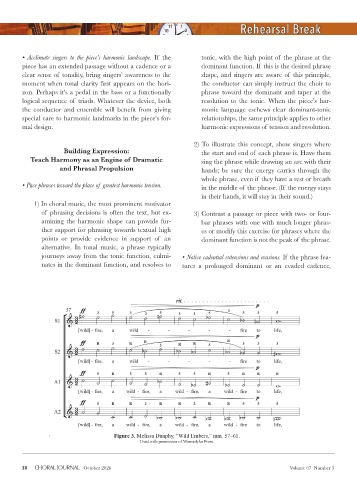
              journeys away from the tonic function, culmi-  • Notice cadential extensions and evasions. If the phrase fea-
              nates in the dominant function, and resolves to   tures a prolonged  dominant or an evaded  cadence,


        38      CHORAL JOURNAL   October 2026                                                  Volume 67  Number 3

