


Page 41 - CJOctober2026
P. 41
make sure singers know when our ears would expect   all harmonies before becoming dissonant) as a means
        the  tension to resolve, understand how the  phrase   of motivating the growth of the sustained pitch and the
        avoids  the  resolution,  and  where  we  finally  earn  the   direction of the phrase overall.
        resolution we’ve waited for. As an exercise, have sing-
        ers imagine they are “riding the roller coaster” of the
        phrase, pretending they cannot anticipate the surprises         Stand-Alone Exercises to
        within the phrase and must experience them turn-by-           Train Harmonic Awareness
        turn.  By bringing singers’ awareness to structural el-
             3
        ements of the composition, conductors can empower   • Arpeggiate together. Play a sonority on the keyboard. In-
        them to budget their own vocal energy and make in-  struct singers to hear the composite sonority, then ar-
        formed musical decisions.                           peggiate it from the bottom to the top and back down
                                                            again, just like they do with the tonic triad in most vo-
        • Look for sustained pitches and notice if  their function chang-  calizes.
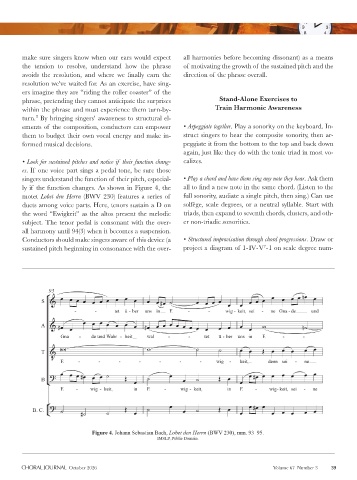
        es. If one voice part sings a pedal tone, be sure those
        singers understand the function of their pitch, especial-  • Play a chord and have them sing any note they hear. Ask them
        ly if the function changes. As shown in Figure 4, the   all to find a new note in the same chord. (Listen to the
        motet Lobet den Herrn (BWV 230) features a series of   full sonority, audiate a single pitch, then sing.) Can use
        duets among voice parts. Here, tenors sustain a D on   solfège, scale degrees, or a neutral syllable. Start with
        the word “Ewigkeit” as the altos present the melodic   triads, then expand to seventh chords, clusters, and oth-
        subject. The tenor pedal is consonant with the over-  er non-triadic sonorities.
        all harmony until 94(3) when it becomes a suspension.
        Conductors should make singers aware of this device (a   • Structured improvisation through chord progressions. Draw or
                                                                                      7
        sustained pitch beginning in consonance with the over-  project a diagram of I-IV-V -I on scale degree num-


        CHORAL JOURNAL  October 2026                                                                                         Volume 67  Number 3          39

