


Page 123 - CJJanuary2026
P. 123
2026 ACDA Southern Region Conference                            March 4-7, 2026                                                    Memphis, Tennessee


        a presenter, clinician, and guest conductor. Originally   SA ensembles; and how shifting the narrative can trans-
        from Alaska, he is a product of the Anchorage School   form the identity and experience of SA singers in our
        District and the University of Alaska Anchorage. After   choral programs.
        teaching middle school in ASD, he completed a mas-
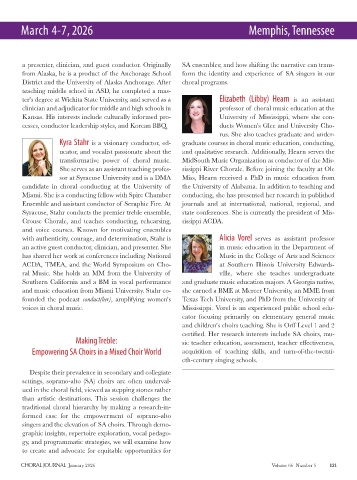
        ter’s degree at Wichita State University, and served as a       Elizabeth (Libby) Hearn  is  an  assistant
        clinician and adjudicator for middle and high schools in        professor of choral music education at the
        Kansas. His interests include culturally informed pro-          University of Mississippi, where she con-
        cesses, conductor leadership styles, and Korean BBQ.            ducts Women’s Glee and University Cho-
                                                                        rus. She also teaches graduate and under-
                    Kyra Stahr is a visionary conductor, ed-  graduate courses in choral music education, conducting,
                    ucator, and vocalist passionate about the   and qualitative research. Additionally, Hearn serves the
                    transformative  power  of  choral  music.   MidSouth Music Organization as conductor of the Mis-
                    She serves as an assistant teaching profes-  sissippi River Chorale. Before joining the faculty at Ole
                    sor at Syracuse University and is a DMA   Miss, Hearn received a PhD in music education from
        candidate  in  choral  conducting  at  the  University  of   the University of Alabama. In addition to teaching and
        Miami. She is a conducting fellow with Spire Chamber   conducting, she has presented her research in published
        Ensemble and assistant conductor of Seraphic Fire. At   journals  and  at  international,  national,  regional,  and
        Syracuse, Stahr conducts the premier treble ensemble,   state conferences. She is currently the president of Mis-
        Crouse Chorale, and teaches conducting, rehearsing,   sissippi ACDA.
        and  voice  courses.  Known  for  motivating  ensembles
        with authenticity, courage, and determination, Stahr is         Alicia Vorel  serves  as  assistant  professor
        an active guest conductor, clinician, and presenter. She        in music education in the Department of
        has shared her work at conferences including National           Music in the College of Arts and Sciences
        ACDA, TMEA, and the World Symposium on Cho-                     at  Southern  Illinois  University  Edwards-
        ral Music. She holds an MM from the University of               ville,  where  she  teaches  undergraduate
        Southern California and a BM in vocal performance   and graduate music education majors. A Georgia native,
        and music education from Miami University. Stahr co-  she earned a BME at Mercer University, an MME from
        founded  the  podcast  conduct(her),  amplifying  women’s   Texas Tech University, and PhD from the University of
        voices in choral music.                             Mississippi. Vorel is an experienced public school edu-
                                                            cator  focusing  primarily  on  elementary  general  music
                                                            and children’s choirs teaching. She is Orff Level 1 and 2
                                                            certified. Her research interests include SA choirs, mu-
                         Making Treble:                     sic teacher education, assessment, teacher effectiveness,
           Empowering SA Choirs in a Mixed Choir World      acquisition  of  teaching  skills,  and  turn-of-the-twenti-
                                                            eth-century singing schools.
           Despite their prevalence in secondary and collegiate
        settings, soprano-alto (SA) choirs are often underval-
        ued in the choral field, viewed as stepping stones rather
        than  artistic  destinations.  This  session  challenges  the
        traditional choral hierarchy by making a research-in-
        formed  case  for  the  empowerment  of  soprano-alto
        singers and the elevation of SA choirs. Through demo-
        graphic insights, repertoire exploration, vocal pedago-
        gy, and programmatic strategies, we will examine how
        to create and advocate for equitable opportunities for

        CHORAL JOURNAL  January 2026                                                                                        Volume 66  Number 5          121

