


Page 72 - NovemberDecember25
P. 72
Damien Geter’s Cantata for a More Hopeful Tomorrow
pay homage to the ancestors and Black Americans by The title of each movement represents a state of be-
incorporating spirituals in this cantata.” The text cap- ing or an action that occurs during times of difficulty.
4
tures the emotional and psychological landscape of this Fear is a natural response to hardship and is often mani-
historic moment while also providing a message of hope fested physically as well as emotionally. Prayer is a prac-
for the future. tice embraced across religions and is a way to seek com-
Geter uses form, texture, harmony, and text-painting fort and guidance in the face of adversity. Breathing is
to portray the emotional character of each movement. an important component of many meditation practices
Additionally, he recontextualizes historical elements— and can mitigate anxiety by calming the body and mind.
including Johann Sebastian Bach’s Weinen, Klagen, Sor- Resolve refers to a firm determination to act. Hope is the
gen, Zagen, BWV 12; the spirituals “I Want Jesus to Walk belief that despite difficulties, a positive outcome is pos-
With Me” and “There is a Balm in Gilead”; and the sible. It can lead to a sense of peace and optimism. The
Charles Albert Tindley hymn “We’ll Understand It Bet- journey from fear to hope is amplified in numerous ways
ter By and By,” and combines them with poetry of Me- throughout the work, specifically through harmony, tem-
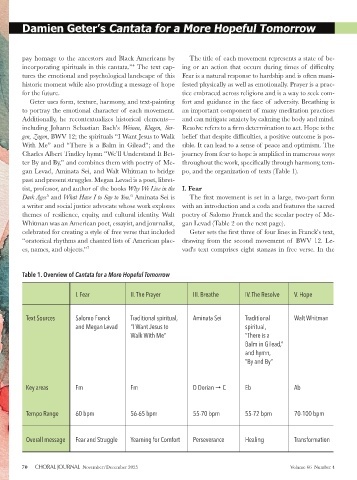
gan Levad, Aminata Sei, and Walt Whitman to bridge po, and the organization of texts (Table 1).
past and present struggles. Megan Levad is a poet, libret-
tist, professor, and author of the books Why We Live in the I. Fear
6
Dark Ages and What Have I to Say to You. Aminata Sei is The first movement is set in a large, two-part form
5
a writer and social justice advocate whose work explores with an introduction and a coda and features the sacred
themes of resilience, equity, and cultural identity. Walt poetry of Salomo Franck and the secular poetry of Me-
Whitman was an American poet, essayist, and journalist, gan Levad (Table 2 on the next page).
celebrated for creating a style of free verse that included Geter sets the first three of four lines in Franck’s text,
“oratorical rhythms and chanted lists of American plac- drawing from the second movement of BWV 12. Le-
es, names, and objects.” 7 vad’s text comprises eight stanzas in free verse. In the
Table 1. Overview of Cantata for a More Hopeful Tomorrow
I. Fear II. The Prayer III. Breathe IV. The Resolve V. Hope
Text Sources Salomo Franck Traditional spiritual, Aminata Sei Traditional Walt Whitman
and Megan Levad “I Want Jesus to spiritual,
Walk With Me” “There is a
Balm in Gilead,”
and hymn,
“By and By”
Key areas Fm Fm D Dorian C Eb Ab
Tempo Range 60 bpm 56-65 bpm 55-70 bpm 55-72 bpm 70-100 bpm
Overall message Fear and Struggle Yearning for Comfort Perseverance Healing Transformation
70 CHORAL JOURNAL November/December 2025 Volume 66 Number 4

