


Page 67 - CJJanuary2026
P. 67
2026 ACDA Midwestern Region Conference                     February 25-28, 2026                                      Milwaukee, Wisconsin


         exploring music  making at  the  margins of society.   considered are: Is this music  and the program that
         Drawing on the presenter’s experience starting a choir   it is a part of relevant? Are we setting our singers up
         in a  women’s correctional  facility, we  will  examine   for success and opportunities to meaningfully engage
         how choral music can restore dignity, build connec-  with the repertoire we have chosen? Does it cultivate
         tion, and foster artistic expression in overlooked spac-  their musical and nonmusical skills to serve? This ses-
         es. Topics include how to begin a program in a prison   sion will provide new national data-based repertoire
         or  similar  setting,  suggested  musical resources,  and   selection  trends, suggest  programming models for
         strategies for building trust and access in nontradition-  choirs of all abilities, and provide resources to ensure
         al ensembles. Participants will also engage in broad-  the music we select is diverse in conceit, origin, and
         er reflection on access, justice, and belonging in the   impact.
         choral world. Whether you’re starting something new
         or reimagining your current community, this session            William McLean is the associate director
         offers practical tools and inspiration to expand your          of choral activities at Baylor University,
         definition of who gets to sing.                                where  he conducts  choirs and teaches
                                                                        courses in conducting and choral litera-
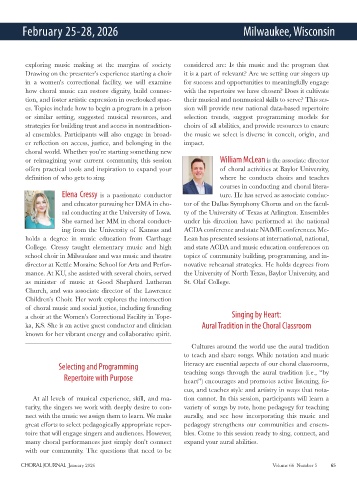
                     Elena Cressy is a  passionate  conductor           ture. He has served as associate conduc-
                     and educator pursuing her DMA in cho-  tor of the Dallas Symphony Chorus and on the facul-
                     ral conducting at the University of Iowa.   ty of the University of Texas at Arlington. Ensembles
                     She earned her MM in choral conduct-   under his  direction have performed at the  national
                     ing from the University of Kansas and   ACDA conference and state NAfME conferences. Mc-
         holds  a degree in  music  education from  Carthage   Lean has presented sessions at international, national,
         College. Cressy taught  elementary music  and high   and state ACDA and music education conferences on
         school choir in Milwaukee and was music and theatre   topics of community building, programming, and in-
         director at Kettle Moraine School for Arts and Perfor-  novative rehearsal strategies. He holds degrees from
         mance. At KU, she assisted with several choirs, served   the University of North Texas, Baylor University, and
         as minister  of music at  Good Shepherd Lutheran   St. Olaf College.
         Church, and was associate director of the Lawrence
         Children’s Choir. Her work explores the intersection
         of choral music and social justice, including founding
         a choir at the Women’s Correctional Facility in Tope-              Singing by Heart:
         ka, KS. She is an active guest conductor and clinician   Aural Tradition in the Choral Classroom
         known for her vibrant energy and collaborative spirit.

                                                               Cultures around the world use the aural tradition
                                                            to teach and share songs. While notation and music
                    Selecting and Programming               literacy are essential aspects of our choral classrooms,
                      Repertoire with Purpose               teaching songs through the aural tradition (i.e., “by
                                                            heart”) encourages and promotes active listening, fo-
                                                            cus, and teaches style and artistry in ways that nota-
            At all levels of musical experience, skill, and ma-  tion cannot. In this session, participants will learn a
         turity, the singers we work with deeply desire to con-  variety of songs by rote, hone pedagogy for teaching
         nect with the music we assign them to learn. We make   aurally, and see how incorporating this music  and
         great efforts to select pedagogically appropriate reper-  pedagogy strengthens our communities and ensem-
         toire that will engage singers and audiences. However,   bles. Come to this session ready to sing, connect, and
         many choral performances just simply don’t connect   expand your aural abilities.
         with our community. The questions that need to be

        CHORAL JOURNAL  January 2026                                                                                        Volume 66  Number 5          65

