


Page 167 - CJJanuary2026
P. 167
2026 ACDA Southwestern Region Conference                   March 4-7, 2026                                        Albuquerque, New Mexico


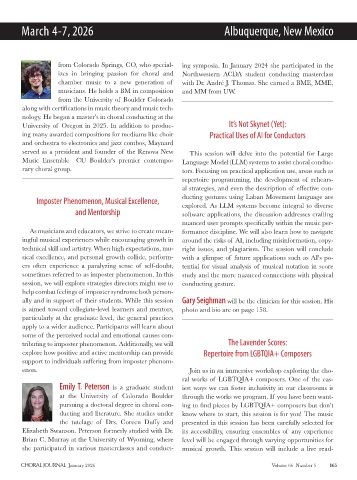
                    from Colorado Springs, CO, who special-  ing symposia. In January 2024 she participated in the
                    izes  in  bringing  passion  for  choral  and   Northwestern  ACDA  student  conducting  masterclass
                    chamber  music  to  a  new  generation  of   with Dr. André J. Thomas. She earned a BME, MME,
                    musicians. He holds a BM in composition   and MM from UW.
                    from the University of Boulder Colorado
        along with certifications in music theory and music tech-
        nology. He began a master’s in choral conducting at the
        University of Oregon in 2025. In addition to produc-               It’s Not Skynet (Yet):
        ing many awarded compositions for mediums like choir         Practical Uses of AI for Conductors
        and orchestra to electronics and jazz combos, Maynard
        served as a president and founder of the Renova New   This  session  will  delve  into  the  potential  for  Large
        Music  Ensemble—CU  Boulder’s  premier  contempo-   Language Model (LLM) systems to assist choral conduc-
        rary choral group.                                  tors. Focusing on practical application use, areas such as
                                                            repertoire programming, the development of rehears-
                                                            al strategies, and even the description of effective con-
             Imposter Phenomenon, Musical Excellence,       ducting gestures using Laban Movement language are
                                                            explored. As LLM systems become integral to diverse
                         and Mentorship                     software applications, the discussion addresses crafting
                                                            nuanced user prompts specifically within the music per-
           As musicians and educators, we strive to create mean-  formance discipline. We will also learn how to navigate
        ingful musical experiences while encouraging growth in   around the risks of AI, including misinformation, copy-
        technical skill and artistry. When high expectations, mu-  right issues, and plagiarism. The session will conclude
        sical excellence, and personal growth collide, perform-  with a glimpse of future applications such as AI’s po-
        ers  often  experience  a  paralyzing  sense  of  self-doubt,   tential for visual analysis of musical notation in score
        sometimes referred to as imposter phenomenon. In this   study and the more nuanced connections with physical
        session, we will explore strategies directors might use to   conducting gesture.
        help combat feelings of imposter syndrome both person-
        ally and in support of their students. While this session  Gary Seighman will be the clinician for this session. His
        is aimed toward collegiate-level learners and mentors,   photo and bio are on page 158.
        particularly at the graduate level, the general practices
        apply to a wider audience. Participants will learn about
        some of the perceived social and emotional causes con-
        tributing to imposter phenomenon. Additionally, we will            The Lavender Scores:
        explore how positive and active mentorship can provide     Repertoire from LGBTQIA+ Composers
        support to individuals suffering from imposter phenom-
        enon.                                                 Join us in an immersive workshop exploring the cho-
                                                            ral works of LGBTQIA+ composers. One of the eas-
                    Emily T. Peterson  is  a  graduate  student   iest ways we can foster inclusivity in our classrooms is
                    at  the  University  of  Colorado  Boulder   through the works we program. If you have been want-
                    pursuing a doctoral degree in choral con-  ing to find pieces by LGBTQIA+ composers but don’t
                    ducting and literature. She studies under   know where to start, this session is for you! The music
                    the  tutelage  of  Drs.  Coreen  Duffy  and   presented in this session has been carefully selected for
        Elizabeth Swanson. Peterson formerly studied with Dr.   its accessibility, ensuring ensembles of any experience
        Brian C. Murray at the University of Wyoming, where   level will be engaged through varying opportunities for
        she participated in various masterclasses and conduct-  musical  growth.  This  session  will  include  a  live  read-


        CHORAL JOURNAL  January 2026                                                                                        Volume 66  Number 5          165

