


Page 28 - CJOctober2026
P. 28
World Musics & Cultures
                          World Musics & Cultures


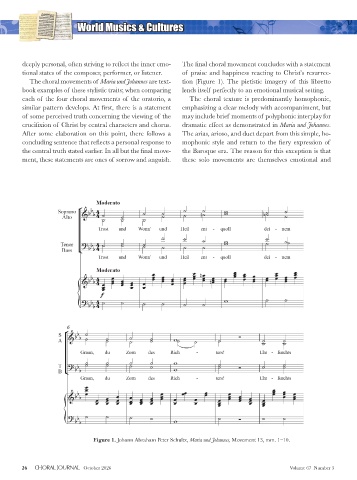
        deeply personal, often striving to reflect the inner emo-  The final choral movement concludes with a statement
        tional states of the composer, performer, or listener.  of praise and happiness reacting to Christ’s resurrec-
           The choral movements of Maria und Johannes are text-  tion (Figure 1). The pietistic imagery  of this  libretto
        book examples of these stylistic traits; when comparing   lends itself perfectly to an emotional musical setting.
        each of the four choral movements of the oratorio, a   The choral texture is predominantly homophonic,
        similar pattern develops. At first, there is a statement   emphasizing a clear melody with accompaniment, but
        of some perceived truth concerning the viewing of the   may include brief moments of polyphonic interplay for
        crucifixion of Christ by central characters and chorus.   dramatic effect as demonstrated in Maria und Johannes.
        After some elaboration on this point, there follows a   The arias, arioso, and duet depart from this simple, ho-
        concluding sentence that reflects a personal response to   mophonic style and return to the fiery expression of
        the central truth stated earlier. In all but the final move-  the Baroque era. The reason for this exception is that
        ment, these statements are ones of sorrow and anguish.   these  solo movements  are  themselves emotional  and


                               Figure 1. Johann Abraham Peter Schultz, Maria und Johannes, Movement 13, mm. 1–10.


        26      CHORAL JOURNAL   October 2026                                                  Volume 67  Number 3

