


Page 11 - CJOctober2026
P. 11
“A Great Deal of Life”   Cultivating Shared Knowing in Choral Commissioning


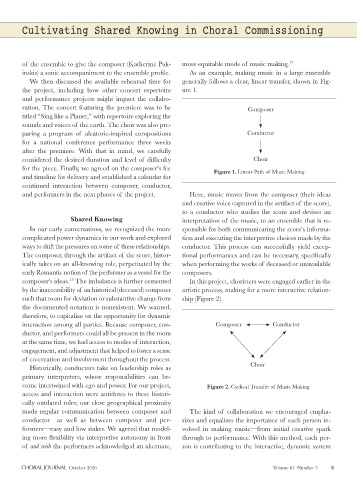
        of the ensemble to give the composer (Katherine Puk-  more equitable mode of music making. 14
        inskis) a sonic accompaniment to the ensemble profile.  As an example, making music in a large ensemble
           We then discussed the available rehearsal time for   generally follows a clear, linear transfer, shown in Fig-
        the project, including how  other  concert repertoire   ure 1.
        and performance projects  might impact  the  collabo-
        ration. The concert featuring the premiere was to be                     Composer
        titled “Sing like a Planet,” with repertoire exploring the
        sounds and voices of the earth. The choir was also pre-
        paring  a program of aleatoric-inspired compositions                     Conductor
        for  a  national  conference  performance  three  weeks
        after  the  premiere.  With  that  in mind, we  carefully
        considered the desired duration and level of difficulty                    Choir
        for the piece. Finally, we agreed on the composer’s fee       Figure 1. Linear Path of Music Making
        and timeline for delivery and established a calendar for
        continued interaction  between composer, conductor,
        and performers in the next phases of the project.     Here, music moves from the composer (their ideas
                                                            and creative voice captured in the artifact of the score),
                                                            to a conductor who studies the score and devises an
                        Shared Knowing                      interpretation of the music, to an ensemble that is re-
           In our early conversations, we recognized the more   sponsible for both communicating the score’s informa-
        complicated power dynamics in our work and explored   tion and executing the interpretive choices made by the
        ways to shift the pressures on some of these relationships.   conductor. This process can successfully yield excep-
        The composer, through the artifact of the score, histor-  tional performances and can be necessary, specifically
        ically takes on an all-knowing role, perpetuated by the   when performing the works of deceased or unavailable
        early Romantic notion of the performer as a vessel for the   composers.
        composer’s ideas.  The imbalance is further cemented   In this project, choristers were engaged earlier in the
                       13
        by the inaccessibility of an historical (deceased) composer   artistic process, making for a more interactive relation-
        such that room for deviation or substantive change from   ship (Figure 2).
        the documented notation is nonexistent. We wanted,
        therefore, to capitalize on the opportunity for dynamic
        interaction among all parties. Because composer, con-          Composer                    Conductor
        ductor, and performers could all be present in the room
        at the same time, we had access to modes of interaction,
        engagement, and adjustment that helped to foster a sense
        of co-creation and involvement throughout the process.
           Historically, conductors take on leadership roles as                   Choir
        primary  interpreters, whose  responsibilities can  be-
        come intertwined with ego and power. For our project,       Figure 2. Cyclical Transfer of Music Making
        access and interaction were antidotes to these histori-
        cally outdated roles; our close geographical proximity
        made regular communication between composer and       The kind of collaboration we encouraged empha-
        conductor—as well  as between  composer and per-    sizes and equalizes the importance of each person in-
        formers—easy and low stakes. We agreed that model-  volved  in making music—from initial  creative  spark
        ing more flexibility via interpretive autonomy in front   through to performance. With this method, each per-
        of and with the performers acknowledged an alternate,   son is contributing to the interactive, dynamic system


        CHORAL JOURNAL  October 2026                                                                                         Volume 67  Number 3          9

