


Page 24 - CJMay2026
P. 24
World Musics & Cultures  Repertoire & Resources
                          World Musics & Cultures  Reper              toire & Resources


        ese to music due to pronunciation challenges. There   gelical purposes.
        has, however, been a heightened interest in the com-  When  Chinese  musicians  immigrated  to  Hong
        position and performance of Cantonese choral works   Kong from China in the  1950s, most of them  only
        within the Cantonese-speaking community in the last   knew Mandarin. They did not know Cantonese and
        two decades. Since 2019, at least six concerts dedicat-  thus did not compose works in the language. The po-
        ed to Cantonese choral works have been held in Hong   litical background of China’s resistance against Japan
              5
        Kong.  The purpose of this article is to investigate the   created a trend for composing patriotic pieces in Man-
        factors behind the delayed development of Cantonese   darin. Some examples of these political works include
        choral music and explore its growing prominence. Re-  “Protect  China” (保衛中華)  and  “Full  River  Red”
        sources are offered at the end of the article for those   (滿江紅) by Lin Shengyi (林聲翕). Between the 1950s
        interested in learning more about this genre.       and 2000s, a second and third generation of Chinese
                                                            composers completed their studies and wrote music in
                                                            various genres. Although choral  works  existed,  most
             Factors Behind Delayed Development             of these  composers’ musical output  was instrumen-
                                                            tal, chamber, or traditional Chinese music. Any cho-
        One. Delayed Emergence of  a Local Identity         ral works of the period were mostly in Mandarin, not
           The combination of British colonization and Chi-  Cantonese.
        na’s political affairs delayed the development of a lo-
        cal identity in Hong Kong. Cultural critic Chiu Loi-  Three. Difficulty of  Setting Cantonese Text to Choral Music
        fat commented that pre-World War II colonial Hong     Cantonese  is  a tonal  language, meaning the  pitch
        Kong never established a cultural identity independent   or pitch pattern to which a syllable is pronounced is
                                                                                                     9
        of China.  Things changed in the 1970s, when Chinese   crucial to understanding the word’s meaning.  Words
                 6
        finally became the second official language, along with   are differentiated by the change of pitches. One must
                              7
        English, in Hong Kong.  Postwar baby boomers who    raise, maintain, or lower the relative pitch to accurate-
        grew up and were educated in Hong Kong shifted from   ly pronounce the words. Unlike musical tones, linguis-
        a migrant mentality to being in active search for their   tic tones are not set at an absolute pitch. Instead, the
        own identity and sense of belonging in Hong Kong.  It   change of pitches is relative. Although Cantonese and
                                                      8
        was only then that the call for local cultural art started   Mandarin share the same written characters, they can-
        to emerge. In the 1970s, Cantopop, a contraction of   not be set to music in the same manner. While both are
        “Cantonese  pop music,”  became  increasingly popu-  tonal languages, Cantonese has two more tones than
        lar in Asian countries, reaching its height between the   Mandarin. Using melodies initially set for Mandarin to
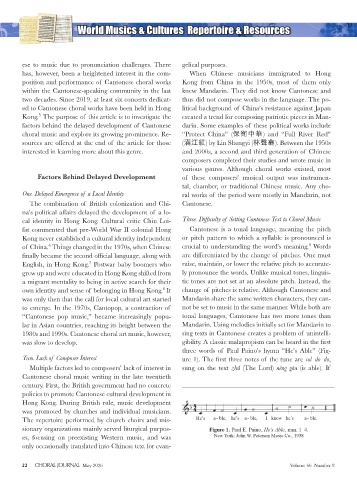
        1980s and 1990s. Cantonese choral art music, however,   sing texts in Cantonese creates a problem of unintelli-
        was slow to develop.                                gibility. A classic malapropism can be heard in the first
                                                            three words of Paul Paino’s hymn “He’s Able” (Fig-
        Two. Lack of  Composer Interest                     ure 1). The first three notes of the tune are sol–do–do,
           Multiple factors led to composers’ lack of interest in   sung on the text zhǔ (The Lord) néng gòu (is able). If
        Cantonese choral music writing in the late twentieth
        century. First, the British government had no concrete
        policies to promote Cantonese cultural development in
        Hong Kong. During British rule, music development
        was promoted by churches and individual musicians.
        The repertoire performed by church choirs and mis-
        sionary organizations mainly served liturgical purpos-
        es,  focusing  on  preexisting  Western  music,  and  was
        only occasionally translated into Chinese text for evan-


        22      CHORAL JOURNAL  May 2026                                                       Volume 66  Number 8

