


Page 18 - CJMay2026
P. 18
Chamber Music by James Joyce: A Choral Commissioning Project


        sense  of  melancholy.  The  instrumental  accompani-           The Recording Sessions
        ment momentarily recedes into an organ-like timbre,
        reinforcing the reflective quality. David then strategi-
        cally foregrounds the cello and violin once more, inten-  Scheibe: How do you plan the recording sessions?
        sifying the piece’s emotional depth before the choir’s
        dramatic proclamation—“for many a choir is singing   Earley: We typically schedule five three-hour sessions
        now”—pierces  the  introspection.  His  music  thought-  each recording patch, starting on an evening, which al-
        fully mirrors the poem’s tension between memory and   lows for sound balance, fixing the mics, etc. This is usu-
        loss, deliberately resisting resolution. (Listen to a sam-  ally followed by two full days of recording. You know,
        ple of this track by scanning the QR code on page 8.)   the tradition—or the way we do it anyway, certainly in
                                                            Ireland and in the UK—is a three-hour session with
        Scheibe: I note as well that you were inspired to set   a twenty-minute break included in the middle of the
        one of the poems yourself. Can you tell us about Poem   session. This is then followed by lunch, then another
        XXIV  “Silently,  she’s  combing,  combing  her  long   three-hour session with a break in the middle. There
        hair?”

        Earley: This poem evoked an image of the Rapunzel
        story for me, with an imagined mirror (in my mind’s
        eye), suggesting a duet structure about the choir: one
        soprano line the person, the other the reflection.


                      Silently she’s combing,
                       Coming her long hair,
                      Silently and graciously,
                      With many a pretty air.


           I wanted to create a sonic mirror that suggests two
        selves: a literal reflection and a metaphorical introspec-
        tion. Hopefully the vocal interplay mirrors this duali-
        ty, enhancing the reflective atmosphere. Joyce’s poetic
        reference to “witchery” later in the poem gave me the
        idea to include a harpsichord. In this context the sound
        of the harpsichord—other than the fact that it is my
        primary instrument—evokes a magical ambiance.
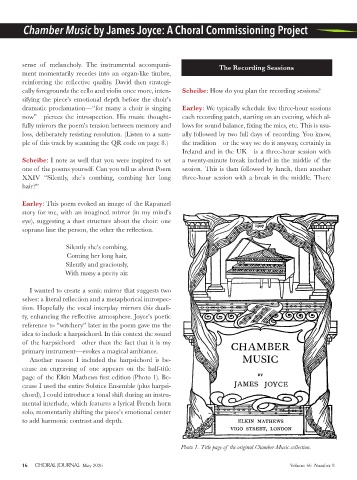
           Another  reason  I  included  the  harpsichord  is  be-
        cause  an  engraving  of  one  appears  on  the  half-title
        page of the Elkin Mathews first edition (Photo 1). Be-
        cause I used the entire Solstice Ensemble (plus harpsi-
        chord), I could introduce a tonal shift during an instru-
        mental interlude, which features a lyrical French horn
        solo, momentarily shifting the piece’s emotional center
        to add harmonic contrast and depth.


                                                           Photo 1. Title page of  the original Chamber Music collection.


        16      CHORAL JOURNAL  May 2026                                                       Volume 66  Number 8

