


Page 77 - CJJanuary2026
P. 77
2026 ACDA Northwestern Region Conference                                       March 4-7, 2026                                                                      Tacoma, Washington


                                             E nc oun  t er C hoirs
                                             Encounter Choirs


                         Force of Nature:                   sion is to use the power of music to connect with the
             Singing and Resistance in the Baltic Region    community and continue to celebrate cultural heritage
                                                            through the arts. Our philosophy as both a specialized
           A presentation of history, stories, and repertoire fo-  repertoire ensemble and a treble ensemble is to demon-
         cusing on the importance of choral music in the Baltic   strate the effect music can have for empowerment, both
         region, the use of nature as a metaphor during times of   in social responsibility and gender identity.
         censorship, and the vital role women played in the re-
         sistance movements. At the centerpiece of the session is       Heather MacLaughlin Garbes is affiliate
         the composition “Div’ dūjiņas gaisā skrēja” by Latvian         assistant professor  at the  University  of
         composer Laura Jēkabsone. “Dedicated to the ‘Daugh-            Washington,  where she  helped develop
         ters of the Forest’—Latvian women who got involved             and maintains the UW Baltic Choral Li-
         in the partisan movement, which stood up against oc-           brary, the first collection of its kind in the
         cupation and Soviet rule  after  World War II. Living   United States. She is also founder and artistic director
         in inhumane circumstances for many years, in a state   of the Mägi Ensemble. MacLaughlin Garbes has pre-
         of constant fear, hiding, and sacrificing themselves in   sented at ACDA national and region conferences, Col-
         the name of Freedom” (Jēkabsone). The audience will   lege Music Society’s national and international confer-
         learn about the importance of singing in resistance and   ences, the Library of Congress, and the Association for
         cultural identity in the Baltic and how women were and   the Advancement of Baltic  Studies  conferences. She
         still are an integral part of those elements. New and   coauthored  the  chapter  “Baltic  Languages:  Latvian,
         rarely heard pieces by  women-identifying  composers   Lithuanian, and Estonian” in the book The Use of  the
         from the Baltic region will also be showcased.     International Phonetic Alphabet in the Choral Rehearsal (Scare-
                                                            crow Press). She has conducted collegiate and commu-
                                                            nity ensembles in Seattle, Chicago, and Houston.
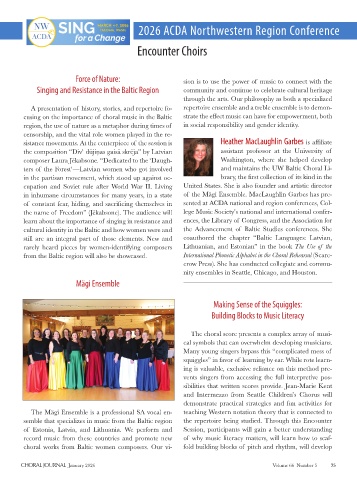
                          Mägi Ensemble

                                                                      Making Sense of the Squiggles:
                                                                     Building Blocks to Music Literacy


                                                               The choral score presents a complex array of musi-
                                                            cal symbols that can overwhelm developing musicians.
                                                            Many young singers bypass this “complicated mess of
                                                            squiggles” in favor of learning by ear. While rote learn-
                                                            ing is valuable, exclusive reliance on this method pre-
                                                            vents singers from accessing the full interpretive pos-
                                                            sibilities that written scores provide. Jean-Marie Kent
                                                            and Intermezzo  from Seattle  Children’s Chorus will
                                                            demonstrate practical strategies and fun activities for
           The Mägi Ensemble is a professional SA vocal en-  teaching Western notation theory that is connected to
         semble that specializes in music from the Baltic region   the repertoire being studied. Through this Encounter
         of Estonia, Latvia, and Lithuania. We perform and   Session, participants will gain a better understanding
         record music from these countries and promote new   of why music literacy matters, will learn how to scaf-
         choral works from Baltic women composers. Our vi-  fold building blocks of pitch and rhythm, will develop


        CHORAL JOURNAL  January 2026                                                                                        Volume 66  Number 5          75

