


Page 178 - CJJanuary2026
P. 178
2026 ACDA Western Region Conference                                                          March 4-7, 2026                                                                  San Jose, California

                                 Special Events


                   Pre-Conference (Wednesday)                               Keynote Speaker


           Nurturing Our Roots: Elementary-Level Practice         Why We Must Sing Each Other’s Songs:
                and Pedagogy for 21st-Century Choirs            Community, Connection, and Commonality


           Nurturing Our Roots emerges from a desire to attend   These days there is a great fear of appropriation and
        carefully to the beginning of all of our choir programs—  cultural missteps. Folks, out of fear, think it is best to stay
        the unique needs of our youngest singers. Facilitated by  in their own lane, only singing music from their own
        the Tucson Girls Chorus, this workshop will supplement  culture. This is dangerous thinking that works to keep
        the  elementary-level  offerings  already  planned  at  the  us apart. We will explore the ways our various traditions
        Western ACDA Region conference.                     and songs connect. Be sure to attend Melanie’s interest
           This  interactive  workshop  will share  strategies  for  session on Thursday, March 5.
        building engaging choral music programs for K–5 sing-
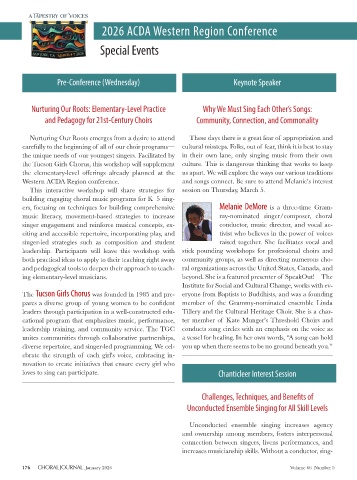
        ers, focusing on techniques for building comprehensive          Melanie DeMore is a three-time Gram-
        music literacy, movement-based  strategies  to  increase        my-nominated singer/composer, choral
        singer engagement and reinforce musical concepts, ex-           conductor, music director, and vocal ac-
        citing and accessible repertoire, incorporating play, and       tivist who believes in the power of voices
        singer-led  strategies  such as composition and student         raised together. She facilitates vocal and
        leadership. Participants will leave this  workshop  with  stick pounding workshops for professional choirs and
        both practical ideas to apply to their teaching right away  community groups, as well as directing numerous cho-
        and pedagogical tools to deepen their approach to teach-  ral organizations across the United States, Canada, and
        ing elementary-level musicians.                     beyond. She is a featured presenter of SpeakOut!—The
                                                            Institute for Social and Cultural Change, works with ev-
        The Tucson Girls Chorus was founded in 1985 and pre-  eryone from Baptists to Buddhists, and was a founding
        pares a diverse group of young women to be confident  member of the Grammy-nominated ensemble Linda
        leaders through participation in a well-constructed edu-  Tillery and the Cultural Heritage Choir. She is a char-
        cational program that emphasizes music, performance,  ter member of Kate Munger’s Threshold Choirs and
        leadership training, and community service. The TGC  conducts song circles with an emphasis on the voice as
        unites communities through collaborative partnerships,  a vessel for healing. In her own words, “A song can hold
        diverse repertoire, and singer-led programming. We cel-  you up when there seems to be no ground beneath you.”
        ebrate the strength of each girl’s voice, embracing in-
        novation to create initiatives that ensure every girl who
        loves to sing can participate.                                  Chanticleer Interest Session


                                                                  Challenges, Techniques, and Benefits of
                                                             Unconducted Ensemble Singing for All Skill Levels


                                                              Unconducted  ensemble  singing increases  agency
                                                            and ownership among members, fosters interpersonal
                                                            connection between singers, livens performances, and
                                                            increases musicianship skills. Without a conductor, sing-


        176      CHORAL JOURNAL  January 2026                                                  Volume 66  Number 5

